Harnessing sunshine to treat mine water
December 3, 2025
Zac Young and Tim Leshuk wanted to help create a water treatment technology to solve a “big, audacious” challenge in the wider world.
That’s when the University of Waterloo nanotechnology grad students turned their gaze westward to mine water in oil sands tailings ponds.
We saw treating mine water with a low-energy technology as a uniquely Canadian challenge that would be meaningful to tackle. And it was very helpful that the oil sands operators were interested in partnering to work on it,” says Young, Chief Operating Officer and co-founder of H2nanO, which started working on the technology in 2015.
The company created a unique treatment solution it calls SolarPass™ — buoyant photocatalyst beads that use sunshine to break down hard-to-treat contaminants in water. This new approach caught the attention of COSIA, the innovation arm of Pathways Alliance, which had put out the call for new low-energy technologies for mine water treatment.
With SolarPass™, sunlight hits the beads and produces a chemical reaction, converting water and oxygen into oxidants that can break down organic contaminants in the mine water.
“The process is like a bunch of little chemical factories that use sunlight as their energy source,” Young says. “The oxidants they generate act like chemical scissors, taking large molecules from the bitumen, such as naphthenic acids, and chemically chopping them up into smaller bits that are lower risk. If they are exposed long enough, they are eventually fully destroyed.”
After a decade of testing, from laboratory concept to off-site trials, H2nanO wrapped up a test demonstration of its photocatalytic treatment at Imperial Oil’s Kearl site earlier in the fall.
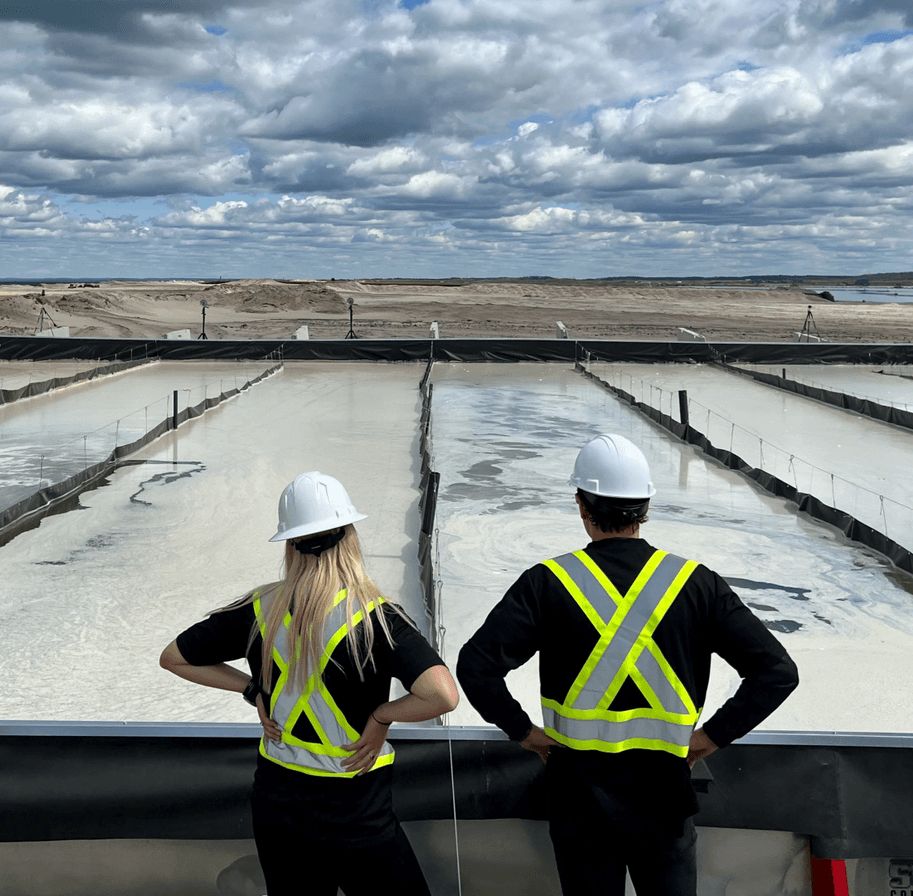
They built a model pond, similar to an aboveground swimming pool. The structure had “raceway” channels for water to flow through circulating pools while exposed to SolarPass.
Working with Pathways Alliance has helped accelerate the development of the technology for H2nanO, helping secure $4.9 million in grants from Emissions Reduction Alberta, Alberta Innovates and the Clean Resource Innovation Network.
“SolarPass requires minimal energy to operate, destroys contaminants instead of generating wastes that need to be landfilled, and doesn’t require hazardous chemicals to be trucked in and stored at site,” Young says. “It is designed to meet the goals of low input, low carbon emissions water management for our mining partners’ goals.”
H2nanO and the oil sands industry also share the same open approach in working with Indigenous communities on treatment technologies for mine water.
“We’ve initiated discussions with communities to understand their perspectives and concerns as we develop and improve this technology. We aim to earn their trust that we’ll meet everyone’s expectations,” he says.
And based on the results to date, Young is optimistic about meeting that “big, audacious” goal set by H2nanO a decade ago.
“We know it’s important because the oil sands are the beating heart of Canada’s energy industry. If they are going to continue to grow, we need to solve this unique challenge of using lower-energy technology to treat mine water stored on their sites,” he says. “By developing new environmental technologies for our energy production, we are working to meet that challenge and that’s something all Canadians want.”