Regulatory
On behalf of the Pathways Alliance member companies, Canadian Natural began filing regulatory applications for the Pathways CO2 Transportation Network and Storage Hub (the Project) in early 2024.
Key regulatory submissions and applications
ANTICIPATED REGULATORY REQUIREMENT
DESCRIPTION
CO2 Transportation Network – Submitted
Pipeline Agreement (PLA) applications
Public Lands Act
Majority of pipeline right-of-way applications (or PLA applications) on Crown land have been filed.
Pipeline – Conservation and Reclamation Plan (White Area only)
Environmental Protection and Enhancement Act
Plan identifies the practices for clearing and soil conservation during construction and requirements for reclaiming the pipeline right-of-way in the White Area. Plan is supplemented by the EPP for the White Area and Environmental Alignment Sheets (EAS).
Pipeline right-of-way
Historical Resources Act
Archaeology and Paleontology Evaluation and Reports submission to seek clearance from the Alberta Ministry of Arts, Culture and Status of Women.
CO2 Transportation Network – Currently under development
PLA Applications – Remaining
Public Lands Act
Pipeline right-of-way on Crown land is currently being finalized.
Pipeline Act and Pipeline Rules Supplemented by Directive 077 (2011) and Canadian Standards Association (CSA Z662)
Technical requirements applicable to the design, construction and operation of oil and gas pipelines in Alberta.
Pipeline – Directive 056 Licences (Supplemented by Directive 71 prior to operation)
Licences for pipeline construction.
Pipeline – Installation Leases (PIL) Applications
Public Lands Act
Above-ground facilities (e.g. metering stations, valve sites) on Crown land.
Pipeline – Regulator Temporary Field Authorization (RTF)
Public Lands Act
Additional temporary activities such as workspace, borrow, access, log decks, sump sites, etc. on Crown land.
Pipeline – Code of Practice Notification
Water Act
Vehicle and pipeline crossings of watercourses and wetlands; hydrostatic testing water withdrawals.
Pipeline Approval
Water Act
Valve sites or facilities that intersect a wetland.
Pipeline – Temporary Diversion Licences
Water Act
Short-term water withdrawals for purposes other than hydrostatic testing.
Pipeline – Requirements under
Fisheries Act
Request for Review (RFR) under Federal Fisheries Act (water withdrawals for pipeline construction, temporary or permanent vehicle crossings, ice bridges). Anything below a high water mark of a stream. Seek Letter of Advice from Fisheries and Oceans Canada (DFO).
Pipeline – Requirements under
Canadian Navigable Waters Act
Notification for pipeline crossings, vehicle crossings, water intakes, and temporary works on navigable waters that comply with the Minor Works Order. No Navigable Waters Act authorizations are anticipated from Transport Canada.
Storage Hub – Currently under development
Injection Scheme – Directive 065 (Resource Application)/Directive 051 (Injection)
Subsurface approval and requirements for CO2 injection including MMV and Closure Plans.
Well Facilities and Injection Wells – Directive 056 Licences (Supplemented by Directive 71 prior to operation)
Licences for well pad facilities and wells.
Community engagement and regulatory approvals
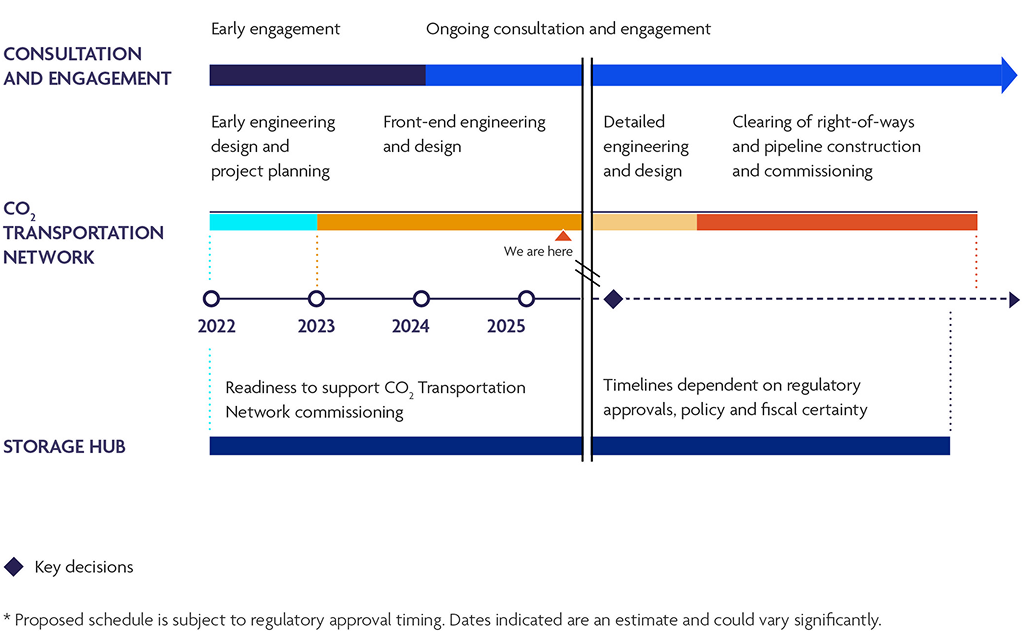
Consultation and engagement with local stakeholders, landowners and Indigenous groups located near the proposed project began in 2023, following early engagement in 2022. On behalf of Pathways Alliance, Canadian Natural continues to work together and exchange information with local stakeholders, landowners and Indigenous groups about the proposed Project.
Although regulatory decisions, approvals and permits are primarily deemed to be required from provincial regulatory bodies, it is also imperative that both provincial and federal governments have regulatory and fiscal frameworks in place that enable Pathways Alliance to proceed with the proposed Project.
Where is the Pathways
Project located?
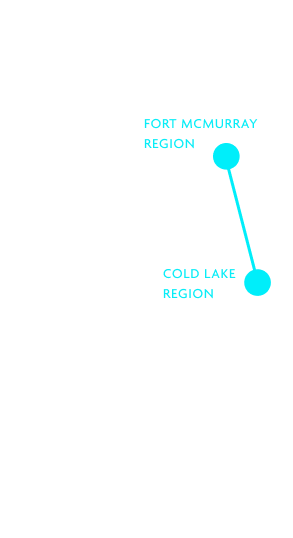
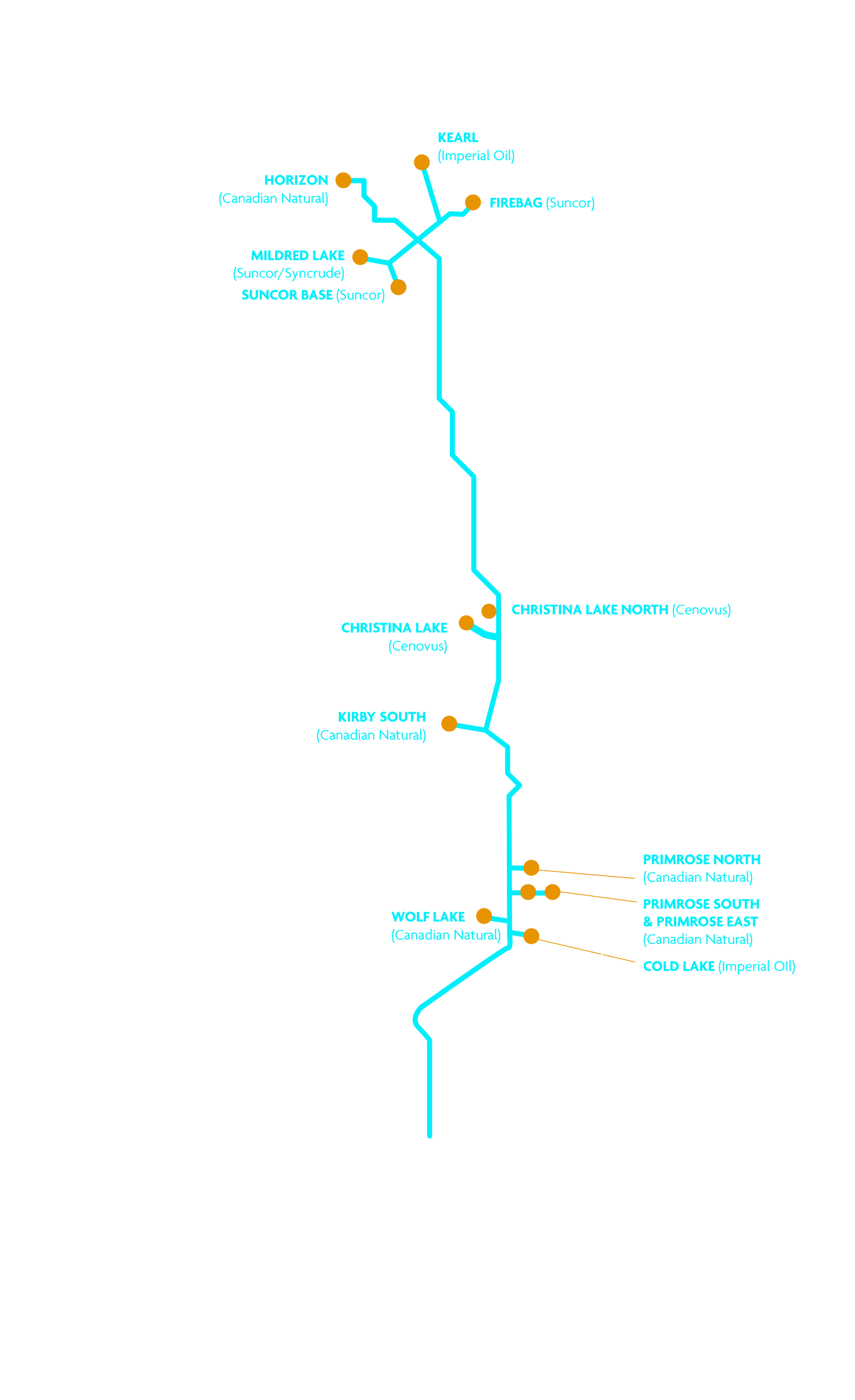
Our proposed Project will involve an approximately 400-kilometre-long main transportation pipeline between the Fort McMurray and Cold Lake regions. An additional 250 km of pipelines will connect oil sands facilities to the main transportation pipeline to form a network.
Where is the Storage Hub?
CO2 will be stored deep underground in a geological formation called the Basal Cambrian Sandstone (BCS). This proposed Storage Hub for the Project is located near the Cold Lake area of Alberta. The CO2 Transportation Network will connect to up to 19 injection well sites within the Storage Hub area. CO2 will be injected into the Storage Hub via these wells.

DRAG MAP TO EXPLORE
Project timeline
Project Overview
August 2025
Get detailed information about the Pathways CO2 Transportation Network and Storage Hub. This overview is intended to be the basis for the consultation and engagement process for the project.
The Project proceeding is contingent upon obtaining sufficient fiscal and policy supports and regulatory approval.
Carbon capture and storage (CCS)
Find out more about CCS and explore other projects like ours around the world.
Safety
Safety and risk management are our top priorities. Get more details and find answers to common questions.
Carbon capture and storage (CCS) process
Find out how the process works, from capture to transportation to storage.