Carbon capture and storage (CCS) process
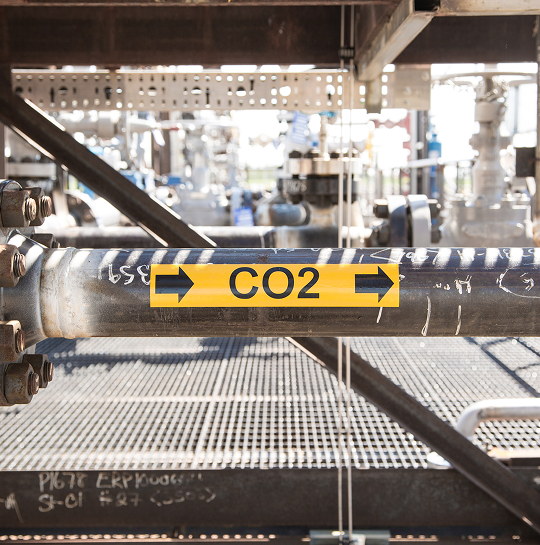
CCS is a process that captures, transports and stores industrial CO2 emissions before they enter the atmosphere. According to the Global CCS Institute’s 2025 Report,1 there are over 77 carbon capture and storage projects in operation and 47 under construction.
How does CCS work?
CCS involves a three-step process: capture, transport and storage.
Capture
Capture technologies are fitted to a large, stationary emission source, like boilers or steam generators, to capture the CO2 contained in the flue gas.*
A chemical compound such as an amine is used to capture the CO2. The amine reacts with the CO2 molecules to separate it from water vapour and nitrogen (which is then released). The amine reagent containing captured CO2 is then heated to separate CO2 from the amine reagent.
Transport
Next, the CO2 is compressed into a fluid form. A specially designed pipeline transports fluid CO2 to a CO2 injection well near a geological formation that is well-suited to store CO2.
Storage
The CO2 is then injected deep underground into a porous rock formation, well below non-saline groundwater
e.g. freshwater wells.
* Flue gas from natural gas-fired boilers contains approximately 10% CO2, 20% H2O, and 70% nitrogen.
Pathways CO2 Transport and Storage Project
Canadian Natural is the proponent of the Project on behalf of Pathways Alliance member companies. CO2 capture facilities will be developed, constructed and operated at individual oil sands sites by their respective operators.
Transport
For the Project, captured CO2 will be transported using pipelines to connect the carbon capture facilities at the oil sands sites to the Storage Hub, where the geological formation that will store the CO2 is located. These buried pipelines will follow existing right-of-ways to the greatest extent possible. Pipelines will be designed, installed and routinely inspected in accordance with Canadian Standards Association (CSA) Z662 standards and the Government of Alberta Pipeline Rules under the Pipeline Act.
Storage
The captured CO2 will be stored in a sandstone formation called the Basal Cambrian Sandstone (BCS).
It is located in the Western Canadian Sedimentary Basin and underlies large parts of Alberta, making the province well-suited for CO2 storage. The BCS is located deep underground (over 1,000 metres within the proposed Storage Hub) and multiple overlying layers of rock salt formations, called cap rock, act as seals to keep the CO2 stored underground.
Monitoring
Throughout the life of the Project, the Storage Hub
will be monitored through a site-specific Monitoring, Measurement and Verification (MMV) Plan developed
in accordance with the Alberta Energy Regulator’s Directive 065.
Capture
*Visuals for illustrative purposes only.

Click or tap on each hot spot to learn more
Transport
*Visuals for illustrative purposes only. Additional facilities not shown.
Click or tap on each hot spot to learn more
Fort McMurray
In situ Sites
Cold Lake Region
Oil sands upgraders, mining and in-situ area
400+ km CO₂ transportation network
Oil sands in-situ recovery area
Joint carbon storage hub
Storage
*Visuals for illustrative purposes only.
Click or tap on each hot spot to learn more
Greater than 1,000 m deep
The Project proceeding is contingent upon obtaining sufficient fiscal and policy supports and regulatory approval.
Carbon capture and storage (CCS)
Learn more about CCS and explore other projects like ours around the world.
Safety
Safety and risk management are our top priorities. Get more details and find answers to common questions.
Regulatory
Learn about the regulatory and approval process for our proposed project.